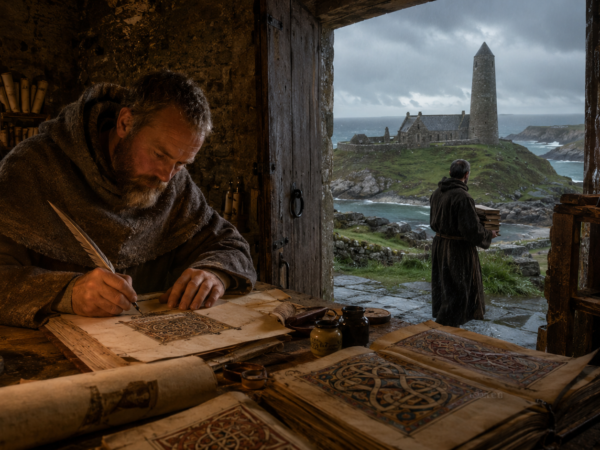
When the Western Roman Empire collapsed and waves of invaders swept across the continent, something precious was nearly lost along with it: the accumulated written knowledge of the classical world. Libraries burned, cities were sacked, and literacy retreated. Yet on a rain-lashed island at the far western edge of Europe, the opposite was happening. In the monasteries of early medieval Ireland, learning was not dying but flowering. Irish monks, working in remote stone settlements, quietly copied and preserved the literature of Greece and Rome while much of Europe descended into what later ages would call the Dark Ages. It is one of history’s great quiet rescues, and it earned Ireland an enduring nickname: the Land of Saints and Scholars.
An island spared the chaos
The story begins with a geographical accident. Christianity arrived in Ireland in the fifth century, associated above all with the missionary work of Saint Patrick, himself a Romano-Briton who had been captured and enslaved by Irish raiders before returning as a bishop. Crucially, Ireland sat beyond the reach of the barbarian invasions that were tearing apart the former Roman territories. It had never been part of the Roman Empire, and so it never suffered the violent unraveling that the empire’s collapse brought to Gaul, Britain, and Italy.
This isolation gave Ireland a rare gift: stability at a moment of continental chaos. While monasteries and towns on the mainland were being plundered, the new Christian communities in Ireland could grow, teach, and build in peace. The sixth and seventh centuries became a golden age of Irish learning, art, and culture, and the engines of that flowering were the monasteries. Unlike the urban centers of the old Roman world, these were self-sustaining settlements, almost like small cities devoted to God, where prayer, farming, teaching, and above all the making of books went on side by side.
The scriptorium and the labor of the pen
At the heart of every great monastery lay the scriptorium, the writing room, and the library it served. Here monks undertook the painstaking, almost unimaginable labor of copying books entirely by hand. Before the printing press, every single volume that survived had to be reproduced letter by letter, line by line, by a scribe bent over a sheet of treated animal skin. A single substantial manuscript could take a team of monks an enormous amount of time and consume the hides of whole herds of calves for its pages.
What the Irish monks chose to copy is what makes their work so historically momentous. They did not confine themselves to scripture and prayer books. They also transcribed the works of the great pagan authors of antiquity, the poetry, philosophy, and history of writers like Virgil, Cicero, and the classical tradition behind them. While invaders elsewhere were looting cities and burning books, Irish scribes were deliberately preserving as much of Western literature as they could lay their hands on. In doing so, they became an unlikely lifeline, a bridge across which the wisdom of the ancient world could pass safely into later centuries.
Art as devotion: the illuminated manuscripts
These books were not mere copies. At their finest they were works of art, and the tradition of Irish illumination produced some of the most beautiful objects of the entire medieval world. The monks transformed the written page into a dazzling fusion of Christian symbolism and native Celtic visual language, filling margins and capital letters with intricate interlacing patterns, spirals, animals, and mythical creatures rendered in vivid pigments.
The supreme surviving example is the Book of Kells, an illuminated copy of the four Gospels in Latin, celebrated as one of the finest medieval manuscripts in existence. Its pages still glow with colors made from materials gathered across the known world, including blue from precious lapis lazuli, a testament to both the artistry and the reach of these supposedly isolated communities. Scholars believe it was begun by monks devoted to Saint Columba on the windswept Scottish island of Iona and completed at the monastery of Kells in Ireland. Its survival across more than a thousand years of raids, upheaval, and neglect makes it a fitting emblem of the whole monastic achievement: fragile knowledge carried, quite literally, through stormy centuries one day at a time.
Sending the light back to Europe
The Irish did not simply hoard their learning at home. The same restless spiritual energy that built the monasteries drove monks outward in a movement they called peregrinatio, a self-imposed pilgrimage for the love of God that scattered Irish scholars across Britain and the continent. Wherever they went, they founded monasteries, and those monasteries became new centers of literacy and book production.
Saint Columba left Ireland to found the hugely influential monastery of Iona off the Scottish coast, from which Irish monks evangelized northern Britain and established further great houses, including Lindisfarne in Northumbria. Saint Columbanus carried the mission deep into Europe, founding monasteries in Gaul and, eventually, the renowned abbey of Bobbio in northern Italy. One of his companions gave his name to the Swiss abbey of Saint Gall, whose library remains famous to this day. At each of these outposts, classical works were recopied and circulated, feeding learning back into a continent that had nearly lost it. When Europe was finally ready for its own revival of scholarship, much of the raw material was waiting, preserved in part through this Irish network. The techniques honed in Irish scriptoria would go on to influence the great manuscript workshops of the later Carolingian renaissance.
This intellectual confidence ran deep. Irish monasteries studied not only literature but the natural world, and an Irish monk of the period could state matter-of-factly that the earth was a sphere, a piece of classical knowledge taken for granted in Ireland while it was forgotten elsewhere. One Irish scholar even compiled a geography describing lands across the known world.
The Viking shadow
This golden age could not last forever, and its undoing came from the sea. Beginning in the late eighth century, Viking raiders discovered that the isolated, undefended monasteries, with their precious metalwork and treasures, made tempting targets. The very remoteness that had once protected these communities now left them dangerously exposed. Iona itself suffered devastating raids, with one assault leaving dozens of the community dead, and the surviving monks fled to Ireland carrying their greatest treasure, the unfinished Book of Kells, to safety.
The monks adapted as best they could, and the distinctive round towers that still dot the Irish landscape are thought to have served partly as refuges and places to safeguard manuscripts and valuables when raiders appeared. But the relentless attacks gradually broke the great age of monastic creativity. Even so, the achievement was already secure. By the time the raids came, generations of Irish scribes had copied, illuminated, and dispersed their books so widely that the knowledge could no longer be extinguished by any single catastrophe.
A debt easily forgotten
It is tempting to imagine the early Middle Ages as a uniform darkness, but the truth is more interesting. On a green island at the edge of the map, in cold stone cells lit by candlelight, monks bent over their desks and made sure the long memory of civilization did not go out. Their patience with the pen, their reverence for the written word, and their willingness to carry it back across the sea helped preserve a heritage that might otherwise have vanished. The next time the phrase Land of Saints and Scholars is heard, it is worth remembering that the scholars earned it, one painstakingly copied page at a time.